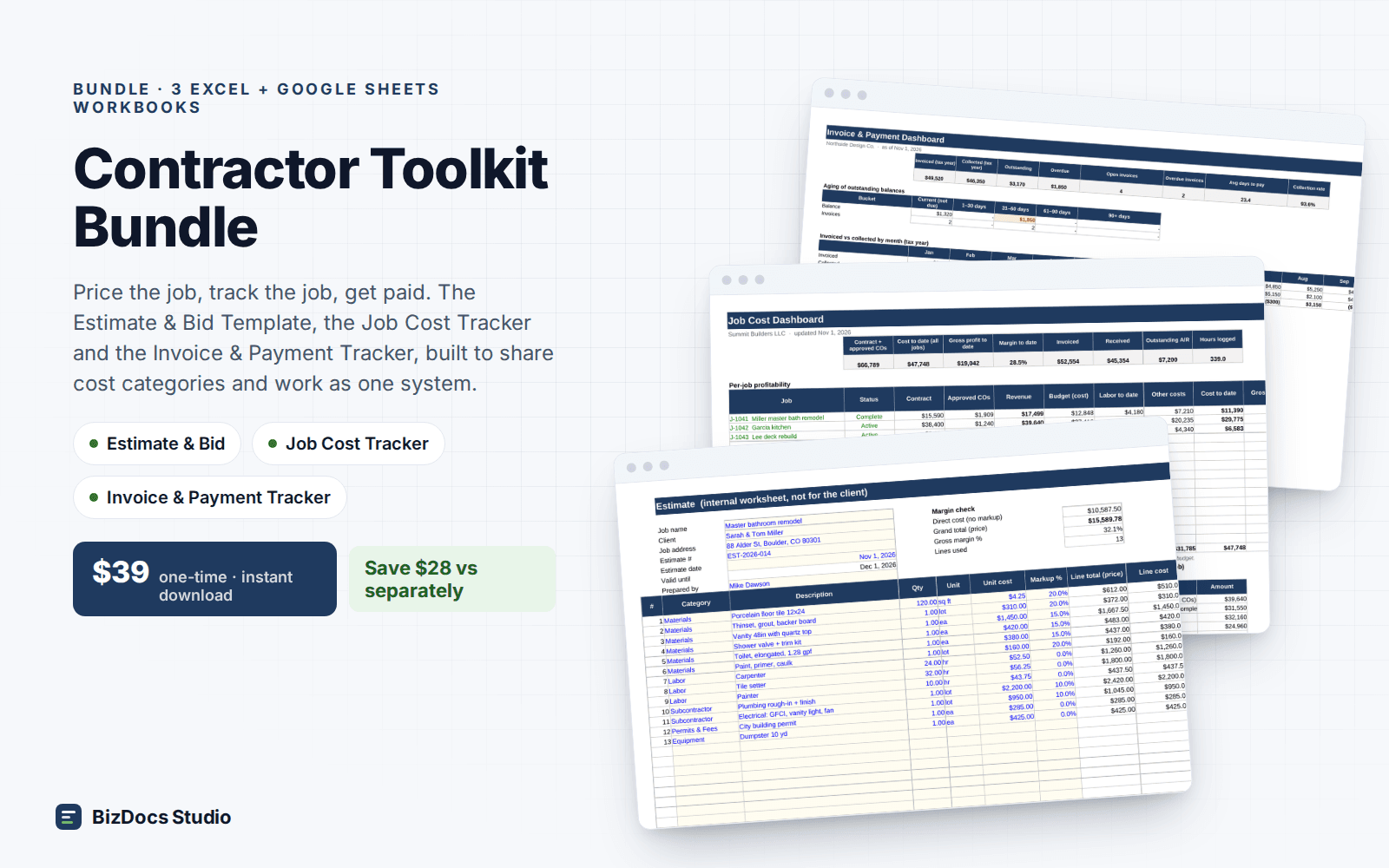
How to write a construction estimate (with a template)
By the BizDocs Studio team · Updated
- •A construction estimate is built from direct costs (materials, labor, subs, equipment) and then marked up for overhead, profit and contingency. Tax is added last.
- •Price labor at the loaded rate: wage plus payroll taxes, workers' comp and benefits, usually 25–40% above the base wage.
- •Overhead is a percentage of direct cost that recovers your yearly fixed costs; profit is added on top of cost plus overhead, not instead of it.
- •Keep the estimate (internal) separate from the proposal (what the client sees), and keep a log of every bid so you know your win rate.
Most small contractors do not lose money because they work slowly. They lose it because the estimate left out overhead, priced labor at the wage instead of the real cost of an hour, or forgot the dumpster. A good construction estimate template makes those omissions impossible: every line follows the same path from cost to price.
This guide walks through that path, shows a worked example for a bathroom remodel, and ends with the template we sell if you want it done for you. Everything here works with a pencil too.
1. Break the job into line items
Write the scope as a list of measurable items, grouped by phase or trade. Each line needs a quantity, a unit and a unit cost. Vague lines (“bathroom finishes”) hide mistakes; specific ones (“porcelain floor tile, 48 sq ft, $4.20/sq ft”) expose them.
- Demolition and disposal (include the dumpster and haul fees)
- Rough work: framing, plumbing, electrical, HVAC
- Materials by item, with waste factor (typically 10% for tile and flooring)
- Subcontractor quotes as lump sums
- Equipment rental and small tools
- Permits, inspections and fees
- Cleanup and final punch list
2. Price labor at the loaded rate, not the wage
A carpenter paid $30 an hour costs you more than $30. Add employer payroll taxes (FICA 7.65% plus state and federal unemployment), workers' compensation insurance, and any paid time off or benefits. The result is the burden percentage.
| Item | Example |
|---|---|
| Base wage | $30.00 / hr |
| Payroll taxes (≈ 9%) | $2.70 |
| Workers' comp (trade-dependent, ≈ 12%) | $3.60 |
| PTO and benefits (≈ 8%) | $2.40 |
| Loaded labor rate | $38.70 / hr (29% burden) |
Multiply estimated hours by the loaded rate. If you work alone, use the hourly amount you need to pay yourself plus your own insurance and taxes.
3. Add overhead as a percentage
Overhead is everything you pay whether or not a job is running: truck, insurance, phone, software, office, accounting, your non-billable time. Add up last year's overhead and divide by last year's direct job costs. That ratio is your overhead percentage; for small residential contractors it commonly lands between 10% and 20%.
From line items to a signed proposal in one file.
4. Add profit on top of cost plus overhead
Profit is what the business earns after every cost, including overhead. Apply it to cost plus overhead. Many residential contractors target 10–15% net profit; the rough rule of “10 and 10” (10% overhead, 10% profit) is a floor, not a target.
Markup is a percentage added to cost. Margin is the percentage of the selling price that is profit.
A 25% markup on $10,000 cost = $12,500 price = 20% margin.
To hit a 20% margin, divide cost by 0.80, not multiply by 1.20.
5. Add contingency and tax last
Contingency covers the unknowns you cannot see until walls are open: 5% for new work, 10–15% for remodels in older homes. Show it as a line or build it into the price, but do not skip it. Sales tax depends on your state: some tax materials only, some tax the whole contract, some neither. Apply the rule your state uses.
Worked example: small bathroom remodel
| Line | Cost |
|---|---|
| Demolition, disposal, dumpster | $1,150 |
| Plumbing rough and fixtures (sub) | $3,400 |
| Electrical: fan, lights, GFCI (sub) | $1,250 |
| Tile, backer board, setting materials | $1,640 |
| Vanity, toilet, mirror, accessories | $2,180 |
| Labor: 62 hrs × $38.70 loaded | $2,399 |
| Permit and inspection | $275 |
| Direct cost subtotal | $12,294 |
| Overhead 15% | $1,844 |
| Profit 12% on cost + overhead | $1,697 |
| Contingency 8% | $1,267 |
| Price before tax | $17,102 |
The same job priced as “cost plus 20%” would have been $14,753, about $2,350 less, and that gap is exactly the overhead and contingency the business needed.
6. Turn the estimate into a proposal
The estimate is your internal math. The client gets a proposal: scope in plain language, a total (and optionally a few allowances), schedule, payment terms, exclusions and a signature line. Never send the internal estimate; it invites line-by-line negotiation of your overhead. See the proposal guide linked below.
7. Log every bid
Write down every bid, its value, and whether you won it. After twenty bids you know your win rate. Winning nearly everything usually means you are too cheap; winning almost nothing means your price, your follow-up or your client fit is off.
Common estimating mistakes that cost margin
| Mistake | What it costs | Fix |
|---|---|---|
| Pricing labor at the wage | 25–40% of every labor dollar | Use the loaded rate on every labor line |
| No overhead line | Your truck, insurance and phone paid from profit | Apply your calculated overhead % to direct cost |
| Markup confused with margin | A “20%” job that really earns 16.7% | Divide by (1 − margin) when targeting margin |
| Forgetting disposal and permits | $500–1,500 on a typical remodel | Keep a standard checklist of non-material costs |
| No waste factor | Short on tile, flooring, drywall | Add 5–15% waste by material |
| No contingency on old homes | Hidden damage eats the profit | 8–15% contingency or a clear hidden-condition clause |
How long should an estimate take?
A small repair should take minutes; a remodel an hour or two including the site visit and supplier quotes. If estimates take longer than that, the problem is usually rebuilding the math from scratch each time. A template with your rates, overhead and profit already in it cuts the work to entering quantities.
Track the time you spend estimating against your win rate. If you win one job in five and each estimate takes three hours, every won job carries fifteen hours of unpaid estimating, which belongs in your overhead.
Free estimate templates vs a pricing system
Free estimate templates from software vendors and office suites are mostly a nicely formatted table: description, quantity, price, total. They do not know your labor burden, your overhead or your profit target, so the price you type is still a guess.
A pricing system starts from cost and applies the same rules to every line. That is the difference between a document that looks professional and a number that keeps the business alive. Use whichever you like for layout; just make sure the math underneath is consistent.
Estimate checklist before you send
- Every scope item from the walkthrough has a line
- Quantities measured, waste added
- Labor hours reviewed against similar past jobs
- Sub quotes current and in writing
- Disposal, permits, equipment and cleanup included
- Overhead, profit and contingency applied
- Sales tax handled per your state's rule
- Proposal shows scope, total, allowances, exclusions, schedule and payment terms
- Bid logged with date and value
Frequently asked questions
What should a construction estimate include?
Scope broken into line items with quantities and unit costs, labor at the loaded rate, subcontractor quotes, materials with waste, equipment, permits, overhead, profit, contingency and sales tax where your state applies it.
What is a good overhead and profit percentage for contractors?
Small residential contractors commonly run 10–20% overhead and target 10–15% net profit. Calculate your own overhead from last year's numbers rather than borrowing a rule of thumb.
Is an estimate the same as a bid or proposal?
The estimate is your internal calculation. A bid or proposal is the document you send the client, built from the estimate but showing scope, price and terms, not your costs.
Can I make a construction estimate in Excel or Google Sheets?
Yes. A spreadsheet is ideal because the markup math is consistent on every line. Our template does this and also produces the proposal, change order and invoice from the same numbers.
How do I calculate my overhead percentage?
Add up last year's overhead (everything not tied to a specific job) and divide by last year's total direct job costs. If overhead was $48,000 and direct costs were $320,000, your overhead is 15%.
Should I charge for estimates?
Many residential contractors give free estimates for straightforward jobs and charge for design work or detailed takeoffs, crediting the fee if the client signs.
From line items to a signed proposal in one file.