Construction invoice template for progress billing (with retainage)
By the BizDocs Studio team · Updated
- •On a job paid in stages, each invoice should come from a schedule of values: the contract split into lines, each with a scheduled value that adds up to the contract sum.
- •Each period you report work completed to date per line, plus materials stored on site but not yet installed. Payment due = total completed and stored, minus retainage, minus what earlier applications already billed.
- •Retainage is a percentage held back until completion, usually set in the contract (5% or 10% is common). Many contracts reduce it once the job reaches a set % complete.
- •Send three things each period: a one-page application summary, a continuation sheet with every line, and an invoice the owner can pay from.
A simple invoice works when the job is a day long. On an addition, a large remodel or any job with a lender draw schedule, the owner wants to see how much of each part of the work is done, what is sitting in the garage waiting to be installed, and why this month's number is what it is. If your invoice cannot show that, it gets questioned, and questioned invoices get paid late.
Progress billing solves this with a schedule of values and a running total. This guide shows how the math works, walks through a real-looking example from a $147,990 addition, and lists the mistakes that cause short payments. It works on paper. The template linked below does the arithmetic for you.
1. Build the schedule of values before the first invoice
The schedule of values (SOV) is the contract price broken into lines that a client can see progress on: site work, foundation, framing, roofing, windows, mechanicals, drywall, finishes, cleanup. Each line gets a scheduled value. The lines must add up exactly to the contract sum, so agree on the SOV at signing, not at the first draw.
Make the lines small enough that progress is visible. "Interior finishes, $38,000" invites an argument about 40% versus 60%. Drywall, trim, flooring, tile and paint as separate lines do not.
- One line per trade or phase the owner can walk and see
- General conditions billed in equal monthly amounts
- Approved change orders added as new lines, never folded into an existing line
- Deductive change orders (credits) as negative lines
2. Each period: work completed, stored materials, retainage
For every line, record the total % complete to date, not just this month's progress. Dollars to date = scheduled value x % complete. The difference from last period is the work completed this period.
Stored materials are items delivered and protected but not installed yet: windows in the garage, a tub in the basement. Many contracts allow billing for them with proof such as delivery tickets or photos. When they are installed, the amount moves out of stored materials and into work completed.
Retainage is then held on both. Check your contract: some hold the same rate on stored materials, some a different one.
| Line | How it is calculated |
|---|---|
| Contract sum to date | Original contract + approved change orders |
| Total completed and stored | Work completed to date + materials stored now |
| Retainage | Rate x work completed + rate x stored materials |
| Earned less retainage | Total completed and stored minus retainage |
| Less previous applications | Earned less retainage on the last application |
| Current payment due | Earned less retainage minus previous applications |
| Balance to finish incl. retainage | Contract sum to date minus earned less retainage |
Every figure is cumulative: recompute the total to date and subtract what was already billed. That makes progress billing self-correcting. If you over-reported a line last month, lowering its % this month reduces the payment due.
Worked example: application 4 on a $147,990 addition
A family room and bath addition, original contract $142,400. Three change orders: skylights (+$3,450), a patio door and steps (+$2,780) and a deleted closet built-in (-$640). Contract sum to date: $147,990. Retainage is 10% until the job is 50% complete, then 5% on new work. The project crossed 50% on application 3, so application 4 is the first at 5%.
| Application 4 (period ending 10/31) | Amount |
|---|---|
| 1. Original contract price | $142,400.00 |
| 2. Change orders approved to date, net | $5,590.00 |
| 3. Adjusted contract price | $147,990.00 |
| 4. Work done plus materials stored, to date | $119,503.00 |
| Work completed: $114,153.00 Stored materials: $5,350.00 | |
| 5a. Retainage on work: $8,735.00 held through app 3 + 5% of $26,803.00 new work | $10,075.15 |
| 5b. Retainage on stored materials: 10% of $5,350.00 | $535.00 |
| 6. Earned to date after retainage (line 4 minus line 5) | $108,892.85 |
| 7. Less amounts billed on earlier applications | $78,615.00 |
| 8. Amount due this application | $30,277.85 |
| 9. Remaining to bill, including retainage | $39,097.15 |
The owner paid application 3 short by $500 while a skylight flashing fix was pending. That $500 is not part of line 8, because line 7 is what earlier applications billed, not what was paid. It goes on the invoice as a separate line: amount due this invoice $30,277.85, unpaid from earlier invoices $500.00, total now due $30,777.85.
Progress invoices by schedule of values, with retainage, stored materials and the amount due each period.
3. Retainage reduction: two ways contracts write it
Many contracts lower retainage once the work reaches a set point, commonly 50% complete. Read the clause closely, because there are two different meanings:
- New work only: retainage already held stays held; work billed after the trigger is held at the lower rate. In the example, $8,735 stays held and only the $26,803 of new work is held at 5%.
- All work to date: the lower rate is applied to everything completed, which releases part of what was held. In the example, 5% of $114,153 is $5,707.65, so about $3,000 of retainage would be released on that application.
Also check when it starts: on the application that reaches the trigger, or the one after. And whether the trigger is measured on installed work or includes stored materials. Some states limit retainage on certain kinds of work, so if your contract is silent, ask before you assume a rate.
At the end of the job, bill the retainage on its own final application once the contract's conditions for release (often completion, punch list and final waivers) are met.
4. What to send each period
- Application for payment: the nine-line summary above, a change order summary, your signed statement and a line for the owner's approval.
- Continuation sheet: every SOV line with scheduled value, work from previous applications, this period, stored materials, total, % and balance to finish.
- Invoice: invoice number, due date, the lines billed this period, retainage held, amount due and how to pay.
- Lien waivers if your contract or lender requires them. Use the form your state or contract specifies, and log which ones you sent and received.
Mistakes that cause short payments
- SOV lines that do not add up to the contract sum, so the % complete on the summary never matches the owner's records.
- Billing this period's % instead of % to date, which double counts or under counts every line.
- Front-loading early lines (inflating site work and foundation). Owners and lenders notice, and they hold back the difference.
- Folding change orders into existing lines instead of showing them separately with the application they were approved on.
- Billing stored materials without delivery tickets or photos, or forgetting to move them to work completed once installed.
- Treating a short payment as a lower billing. Keep the application as billed and carry the unpaid amount forward on the next invoice.
Using a template
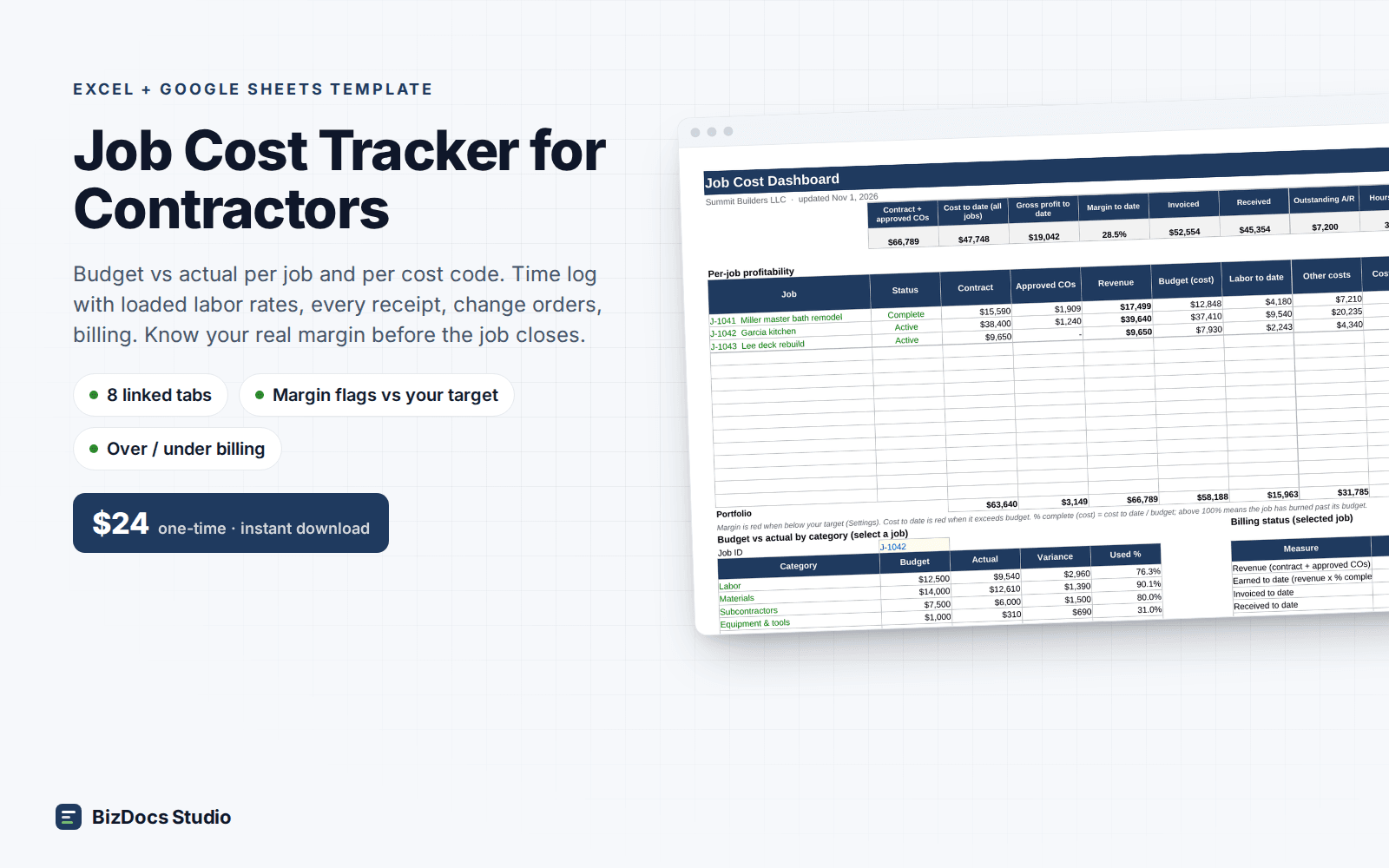
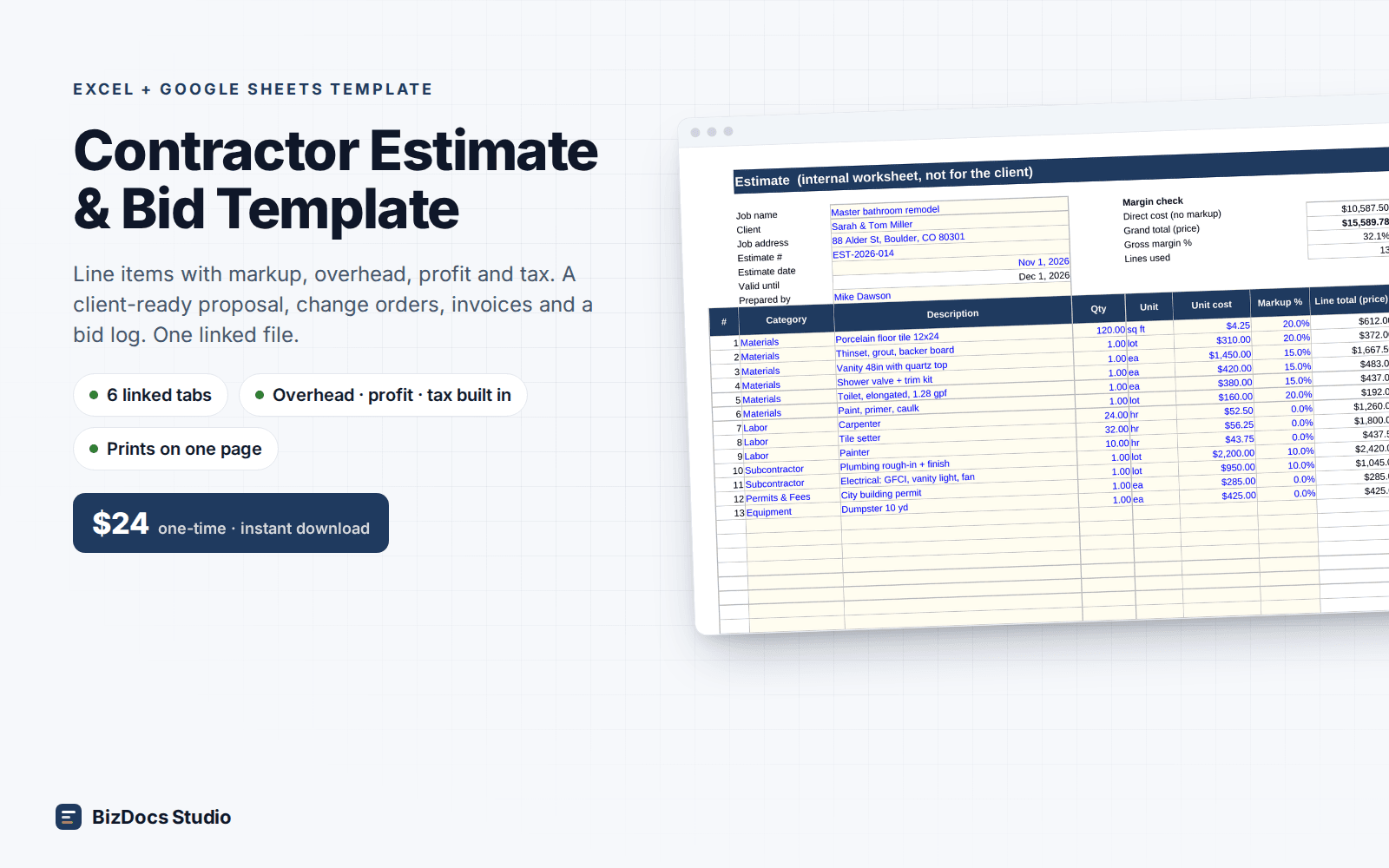
Every number is cumulative and every period repeats the same steps, so a spreadsheet fits. Our Construction Invoice & Progress Billing Template holds 40 SOV lines and 12 periods. You type % complete per line; it calculates retainage with either reduction method, payment due and any unpaid balance, prints the application, continuation sheet and invoice on one page each, and logs payments and lien waivers. Pair it with the Job Cost Tracker to watch margin while you bill.
Frequently asked questions
What is a schedule of values in construction?
A list of the parts of the work with a dollar value for each, adding up to the contract sum. Each progress invoice reports % complete per line, so the owner can see what they are paying for.
How do you calculate retainage on a progress invoice?
Multiply the retainage rate by work completed to date, and the stored materials rate by materials stored now. Subtract that retainage from total completed and stored, then subtract what earlier applications billed to get the payment due.
Can I bill for materials stored on site?
Often yes, if your contract allows it. Keep delivery tickets or photos, bill them in a separate stored materials column, and move them to work completed once installed.
Is progress billing the same as an AIA G702/G703?
Those are well-known standard forms for the same method. You can bill progress with any clear application and continuation sheet unless your contract requires a specific form.
When is retainage paid?
When the contract's conditions for release are met, usually at completion or substantial completion. Bill it on a final application. Rules on retainage vary by state and contract; check yours.
This guide is general information for US small businesses, not legal advice. Rules vary by state and city; have a local attorney review contracts and notices before use.
Progress invoices by schedule of values, with retainage, stored materials and the amount due each period.